Europe, Now!
BFM — 44
BFM — 44

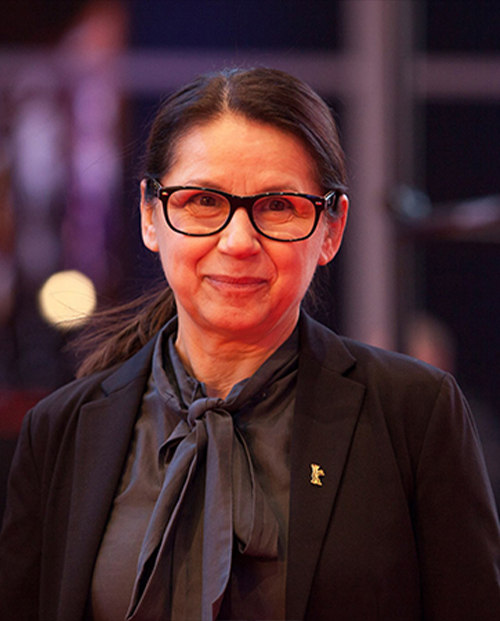
(Budapest, Hungary – 1955)
A central figure in contemporary Hungarian cinema, Ildikó Enyedi has built a consistent, deeply personal body of work over time, marked by a sustained exploration of cinematic language and its boundaries. An award-winning and Oscar-nominated director, Enyedi began her artistic career in the conceptual art and media circuits, within an experimentally oriented context that would have a lasting influence on her creative vision.
After studying economics and film in Budapest and Montpellier, Enyedi joined the Balázs Béla Studio and artistic collectives active in post-communist Hungary, havens of creativity and freedom of expression. Her early works, produced between the late 1970s and early 1980s, already showcase her interest in the relationship between perception, representation and reality: in Flirt: Hipnózis (1979) the author films herself during a hypnotherapy session, while Vakond (The Mole, 1987) conjures up an entire “projected” world, evoking Plato’s allegory of the cave and questioning the very nature of images.
Her feature film debut came in 1989 with Az én XX. Századom (My Twentieth Century), presented at Cannes and awarded the Caméra d’Or. Shot in stylish black-and-white, the film intertwines the fate of twin sisters with the dawn of the modern world, touching on scientific inventions, social transformations, and political utopias. Rather than a historical reconstruction, the film is a poetic meditation on the origins of cinema and how the modern age has redefined our relationship with time, space and human imagination.
In the years that followed, Enyedi alternated between feature films, short films and television work, shifting freely between genres and formats. Films such as Büvös vadász (Magic Hunter, 1994) and Simon mágus (Simon, the Magician, 1999) are presented as detective or fantasy stories. However, they subvert the rules of these genres to explore grey areas where the visible coexists with the invisible and rationality gives way to faith, doubt and illusion. In contrast, works such as Tamás és Juli (Tamás and Juli, 1997) or Első szerelem (First Love, 2008) address romantic love as a place of revelation and vulnerability, filtered through a meticulous, controlled mise-en-scène.
After a period of apparent detachment from cinema – during which Enyedi directed several short films and the series Terápia for HBO Europe – she returned to feature films with Teströl és lélekröl (On Body and Soul, 2017). Set in a slaughterhouse, the film chronicles the encounter between two lonely souls who are unable to communicate in real life but meet every night in their dreams, in the form of deer running free in the woods. Winner of the Golden Bear at the Berlinale and nominated for an Oscar, the film reaffirms the pivotal role of dreams in her aesthetics, seen not as escapism but as a space for authenticity and deep connection between people.
With A feleségem története (The Story of My Wife, 2021), an international co-production presented in competition at Cannes, Enyedi further broadened her perspective by adapting Milán Füst’s eponymous novel. Here, the character played by Gijs Naber, the captain of a cargo ship, discovers that his relationship with his wife, Léa Seydoux, is completely out of control. The result is a reflection on desire and the unsatisfied need to control love, relationships and life. As is often the case in her cinematic work, this film avoids direct commentary, proceeding by subtraction and relying on silences, pauses, and an expansive temporality which questions the world without attempting to explain it.
Finally, her latest film, Stille Freundin (Silent Friend, 2025), premiered at the Venice Film Festival and features a majestic ginkgo biloba tree as its central character, a thousand-year-old arboreal witness to three stories that unfold over an arc of more than a century. Once again, Enyedi invites the viewer on a journey that is more sensory than narrative, letting nature speak for itself. Nature is never simply a backdrop, but a living presence that whispers and questions, a mirror of the soul and a source of revelation for our deepest feelings and instincts.
Alongside her directing work, Enyedi has taken on prominent roles in major international film institutions: she was a member of the main jury at the Berlinale (1990, 2021) and the Venice Film Festival (2018), president of the short film jury at Cannes (2024), and is a member of the Academy of Motion Picture Arts and Sciences and the European Film Academy.
In collaboration with the National Film Institute of Hungary.
Ildikó Enyedi will be in Bergamo from March 10 to 13.
On Wednesday, March 11, starting from 2.30 P.M., the director will hold a masterclass at the Civica Scuola di Cinema Luchino Visconti – Fondazione FM, in Milan (Via Fulvio Testi, 121).
On Thursday, March 12, at 6.45 P.M. the director will meet the public at the Sala Galmozzi – Biblioteca Caversazzi (Via Tasso, 4).
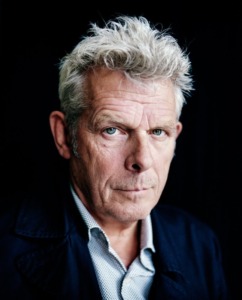
(Haarlem, The Netherlands – 1952)
Is one of the most original and instantly recognisable directors, screenwriters and actors in contemporary Dutch cinema. Trained as a painter and also actively involved in drama as founder of the De Mexicaanse Hond theatre company, he developed a highly distinctive cinematic language characterised by dark, surreal humour, unsettling atmospheres and a critical, grotesque outlook on bourgeois society. In addition to writing the screenplays and stories for his films, he often acts in them as well.
Following his first short film De Stedeling (1984), he made his feature film debut with Abel (1986), the story of a young misanthrope who lives a reclusive life in his parents’ house and observes the world from the window. The film made an immediate impact with its ironic and disturbing style and was a major hit in the Netherlands, where it won several Gouden Kalf awards. With De Noorderlingen (The Northerners, 1992), set in an undeveloped neighbourhood on the fringes of civilisation, van Warmerdam crafted a scathing parable about social hypocrisy and repressed desires, earning widespread international recognition and awards at several festivals, including the Rosa Camuna d’Oro at Bergamo Film Meeting in 1993.
In the following years, he cemented his cinematic universe with films such as De Jurk (The Dress, 1996), a surreal tale that follows the journey of a woman’s dress through a series of bizarre characters and situations, and Kleine Teun (Little Tony, 1998), centred on a love triangle where an illiterate farmer, his wife and a young teacher become entangled in a web of jealousy and black humour. In Grimm (2003), he offers a dark, contemporary reinterpretation of the Brothers Grimm’s fairy tale Brother and Sister, blending horror, irony, and social criticism.
His later works include Ober (Waiter, 2006), a meta-narrative meditation on an author’s power and control over their characters; De laatste dagen van Emma Blank (The Last Days of Emma Blank, 2009), set in a secluded villa where a group of unusual servants live under the rule of the lady of the house. A screen adaptation of a play by van Warmerdam himself, this film is a brutal and grotesque satire on power dynamics and hypocrisy within families. Imbued with van Warmerdam’s signature dark humour, the film was presented in competition at the Venice Film Festival, where it won the Europa Cinemas Label Award. Last but not least, Borgman (2013) tells the story of a mysterious vagrant who infiltrates the life of a wealthy family, resulting in a fierce parable about the underlying violence and hypocrisy of the middle class. Selected for the Official Competition at the Cannes Film Festival, this film marked the director’s rise to international fame.
Schneider vs Bax (2015), a grotesque duel between two hitmen in a seemingly idyllic natural landscape, marks van Warmerdam’s return to a narrative minimalism laden with black humour, which earned him multiple accolades, including the Prix Nouveau Genre at the Festival du Cinéma de Paris.
In 2019, van Warmerdam revisited Grimm’s original footage, reworking it into a new, more compact and stripped-down version titled Grimm Re-Edit. This re-editing is not a mere technical exercise, but a genuine reinterpretation of the original work, which emphasises the fable-like and unsettling elements of the story, while reinforcing the dark and humorous tone typical of his cinema. The film showcases van Warmerdam’s focus on form and editing as tools for narrative reinterpretation, as well as his desire to maintain a critical dialogue with his own creations over time.
His latest film, Nr. 10 (2021) was presented at the Venice International Film Festival and is an inscrutable meditation on identity, heritage, and belonging. The story revolves around Günter, a stage actor who discovers he was found as a child in a forest and is gradually drawn into a mysterious plot involving a secret community. The story blends thriller, existential drama and political symbolism, confirming van Warmerdam’s interest in out-of-place characters, parallel worlds and multi-layered narratives that do not lend themselves to a single interpretation.
Parallel to filmmaking, Alex van Warmerdam has always been active as a painter, novelist, and theatrical director, confirming his consistent, cross-disciplinary approach in which visual arts and storytelling are constantly intertwined.
With the support of SEE NL and in collaboration with Graniet Film.
The producer Marc van Warmerdam will be in Bergamo from March 8 to 10.
On Monday March 9, at 6.30 PM the producer Marc van Warmerdam will meet the public at the Sala Galmozzi – Biblioteca Caversazzi (Via Tasso, 4).
Defined in collaboration with the Civica Scuola di Cinema Luchino Visconti in Milan, the selection of films made by students from European film schools that are members of CILECT presents 8 short films this year, chosen from the winners and finalists of the CILECT Prize 2025, in the categories of animation, fiction and documentary. Created in 2005, the prize is awarded annually by the entire community of students and teachers from the 186 schools that are members of the international association.
In collaboration with CILECT and Civica Scuola di Cinema Luchino Visconti – Fondazione FM